
Damp Course & Timber Preservation
Symptoms
Flaking plaster, spongy soft feel to wall, white powder or crystals appearing on wall, lifting and stained wallpaper, skirting and floor boards rotting.
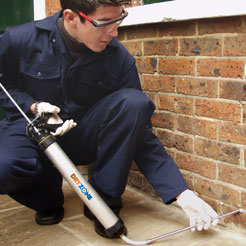
These are all signs of rising damp and if your property is suffering from any of these symptoms, then it is likely that you have a rising damp issue.
Cause
Rising damp can arise for various reasons, the failure of an existing damp proof course (DPC) Bridging due to the raising of external or internal ground levels or in older buildings the complete absence of a damp proof course.
Treatment
Chemical injection damp proof-courses and re-plastering: Injection damp-proof courses basically consist of the injection of a water repellent material into the base of a wall where it will form a diffuse band to 'control' the rising dampness.
Unlike a physical damp proof course which provides an impervious and immediate cut in rising water, the chemical systems will generally only control the rising water -- not stop it. There are a number of physical factors related to the substrate and injection processes which govern why this is.
Therefore, to provide a non-spoiling decorative surface re-plastering is required. First removal of the old plasterwork at a minimum of 1 metre high removes potentially heavy contamination with hygroscopic/deliquescent salts which have accumulated over many years of rising damp and which, if left, may spoil new decorations.
However, the new plasterwork has a very important function -- it must be capable of preventing hygroscopic/deliquescent salts passing to the new surface from contaminated underlying masonry.
This function is extremely important because (a) walls take time to dry down, and (b) the lower part of the walls are always likely to remain damp because of the limitations of the chemical injection systems. Fundamentally, chemical injection damp-proofing is a system -- the injection of the damp proof course to 'control' the rising damp, and the re-plastering to prevent future spoiling -- the processes are inseparable.
Due to our experience in the control of rising damp we can assure that after our treatment walls are dry and ready for decoration within 10 days of the completion of the treatment. All chemicals and fluids used by our self in the control of rising damp are BBA certified for 30 years, thus allowing us to issue 30 year guarantees for all rising damp treatments.
Woodworm Treatment
Structural timbers in UK properties are particularly susceptible to insect and fungal attacks, due to the combination of a predominantly damp, temperate climate and the traditional building methods used in construction. Various types of wet rots, dry rot and woodworm can individually or collectively cause untold damage to the structural timbers in buildings, resulting in costly remedial repairs.
Dry Rot Treatment
Our surveyors are qualified to diagnose not only the type and extent of infestation and decay but also to provide a cost effective long-term solution to the problem.
You can rest assured that the range of remedial wood preservatives and masonry biocides we use are the most up to date products, combining maximum effectiveness with the lowest levels of hazards, both to the health and safety of a building’s occupants and to the environment.

 0151 487 8563
 0773 985 0402